
SM 45 – Feb 15
Edward George Lind bought the Sundridge estate in 1792, and called in Humphry Repton to advise on the landscape. He recommended that the old house should be re-sited on the opposite side of the valley, and that the surrounding farmland should be converted into a park, but, before any improvements had been made to the estate, Lind sold the property to Claude Scott, a wealthy corn merchant, who accepted Repton’s recommendations, and had the new mansion built. John Nash was the appointed architect, and completed the exterior of the building before being replaced by Samuel Wyatt, who completed the Mansion interior.
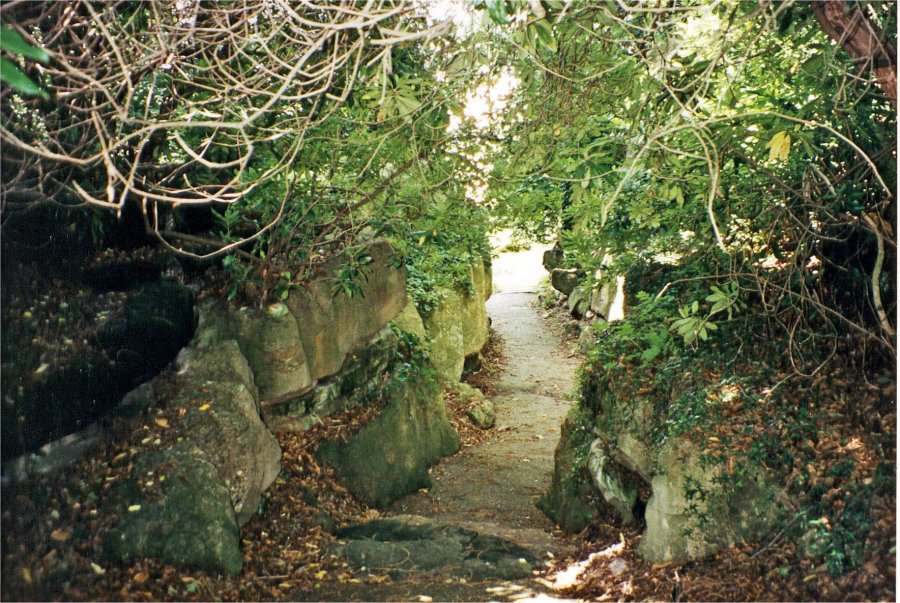
Fig 1 – The pathway through the rocky chasm
Claude Scott was created Baron Scott of Lytchett Manor in 1821 and, when he died in 1830, his son, Samuel – who already lived at Sundridge Park – inherited the title and the 238 hectare estate. Sir Samuel Scott was a keen member of the Horticultural Society of London, and had a large conservatory built by Henry Ormson during the 1820s. It had cast-iron framing and an elaborate curved glass roof, and was heated by the latest hot-water heating system. He later commissioned James Pulham and Son to create a Fernery and Alpinery in the conservatory, but these features no longer survive.
One Pulham feature that does still remain from those days, however, is the
‘Chasm and cliffs’
. . . listed in James 2’s promotional booklet, Picturesque Ferneries and Rock Garden Scenery, published c1877. This was constructed in 1873-74 – a few years after they worked on the remodeling of the lake in Bromley Palace Gardens, which was discussed in my ‘Site of the Month’ feature No 44 for January 2015.
Fig 2 – Looking down the Chasm from the top of the steps
This is a comparatively small installation, and Figs 1 and 2 are pictures of the ‘chasm’ that was either cut – or perhaps already existed – between the high banks on either side of the path, and one of the rocks includes a feature that the Pulhams often incorporated into their work in their attempts to recreate the geological effects of nature. This is a fairly unrealistic group of shells embedded into the surface, and can be seen in Fig 3.
The fifth Baron, Sir Edward Henry Scott (1842-1883), inherited Sundridge in 1880 and made extensive alterations to the mansion. He introduced pheasant-rearing to the estate and organised shooting parties, for which a frequent guest was the then Prince of Wales, later to become King Edward VII.

Fig 3 – Seashells embedded into the surface of the rocks at Sundridge Park
The last of the Scotts to live at Sundridge was Sir Samuel Edward Scott (1873-1943), the sixth baronet. He made two unsuccessful attempts to sell the estate, the larger part of which eventually became known as the Sundridge Park Golf Club. The mansion and coaching buildings were also sold and developed into a hotel, after which it became the Sundridge Park Management Training Centre. When this closed during the 2000s, it reverted to being a top-class hotel, but this closed in 2014, and is currently due for re-development into residential properties. Happily, the Pulham installation is protected, and plans are afoot for it to be included in the steadily increasing list of Pulham restoration sites.
 The Pulham Legacy
Dear Claude,
Good to see this update to your book. I am trying to go and visit the ‘chasm and cliffs’ but see that the Mansion has been turned into posh flats. Do you know the owners? I have written to the Agents to try to find out.
I can add to your description above: ‘This is a fairly unrealistic group of shells embedded into the surface, and can be seen in Fig 3.’ It is real! It is a cemented fossil horizon in the Blackheath Beds (Harwich Formation), better seen in the ornamental arch on the west side of the building in front of the new development there. On the other side of the railway is an SSSI for this fossil/rock bed and we feature both this (GLA 33) and the Pulhamite (GLA 54) in the London Geodiversity Partnerhip Guide to sites within the Greater London Authority. http://www.londongeopartnership.org.uk/guide-to-londons-sites. I have also written it up in my Geologists’ Association Guide No. 68 (Itinerary 7).
For your information Bromley Palace Gardens is also one of the LGP sites (GLA 52).
We have lost touch, probably because my email got changed (see new one below). If you would like me to send more photograhps of the Blackheath cemented fossil bed let me know and I can do so. I have a wonderful historic photograph of the pit dated 2014 that I believe to be somewhere within the grounds of Sundridge Park Mansion. It is massive but I don’t think it includes the cemented material although it is difficult to be sure as they are all long shots.